Introduction
(Aim)
For my digital humanities project, I textually analyzed The Analects of Confucius (from the Chinese Classics) from Project Gutenberg with the aim of uncovering recurring linguistic and thematic patterns that reveal how Confucian thought interweaves personal morality with societal order.
(Methods)
I used a cleaned version of the text file—removing all metadata, licensing information, and extraneous notes—to focus solely on the pure content, and then applied Voyant Tools to generate word clouds, frequency lists, and trend charts.
(Key Results)
The analysis revealed synchronous peaks among key terms—such as virtue, superior, good, propriety, and great, along with government and people—which highlights the interplay of individual and collective ethics throughout the text. While these quantitative findings offer a valuable snapshot, they also suggest that deeper historical and philosophical context, including the roles of governance and the collective ethos, is necessary for full interpretation.
It is also important to note that some terms exhibit nuances lost in translation. For instance, the concept of “chapter” in ancient Chinese texts differs from its modern English interpretation (with “chap” representing shorter sections rather than full chapters), and while “propriety” is neutral in contemporary English, in ancient Chinese culture it is a profoundly positive term. These distinctions underscore the challenges of situating translated classical texts in their proper context.
Sources
(Dataset Used)
I used the text file “The Analects of Confucius (from the Chinese Classics)” from Project Gutenberg. This document contains 29,570 total words and 3,143 unique word forms (according to Voyant Tools).
The dataset originates from a classical work that has been translated across cultures and time, making it an exemplary subject for cross-cultural and cross-temporal studies. As a record primarily composed of dialogues—where Confucius’s disciples meticulously recorded his statements—the text is formatted into 499 chapters, each representing a distinct segment of conversation.
(Cleaning & Formatting)
For the purpose of my analysis, all metadata, license information, and other extraneous notes were removed so that only the pure content remains. This cleaning process ensured that the textual data reflects only the authentic philosophical content, while the preserved chapter divisions maintain the structural integrity of the original work. The clean text file is available here.
Process
(Digital Humanities Methods)
After cleaning the text, I uploaded the pure content to Voyant Tools to perform quantitative analysis. I began by examining the automatically generated word cloud and word frequency list.
(Steps Taken for Analysis)
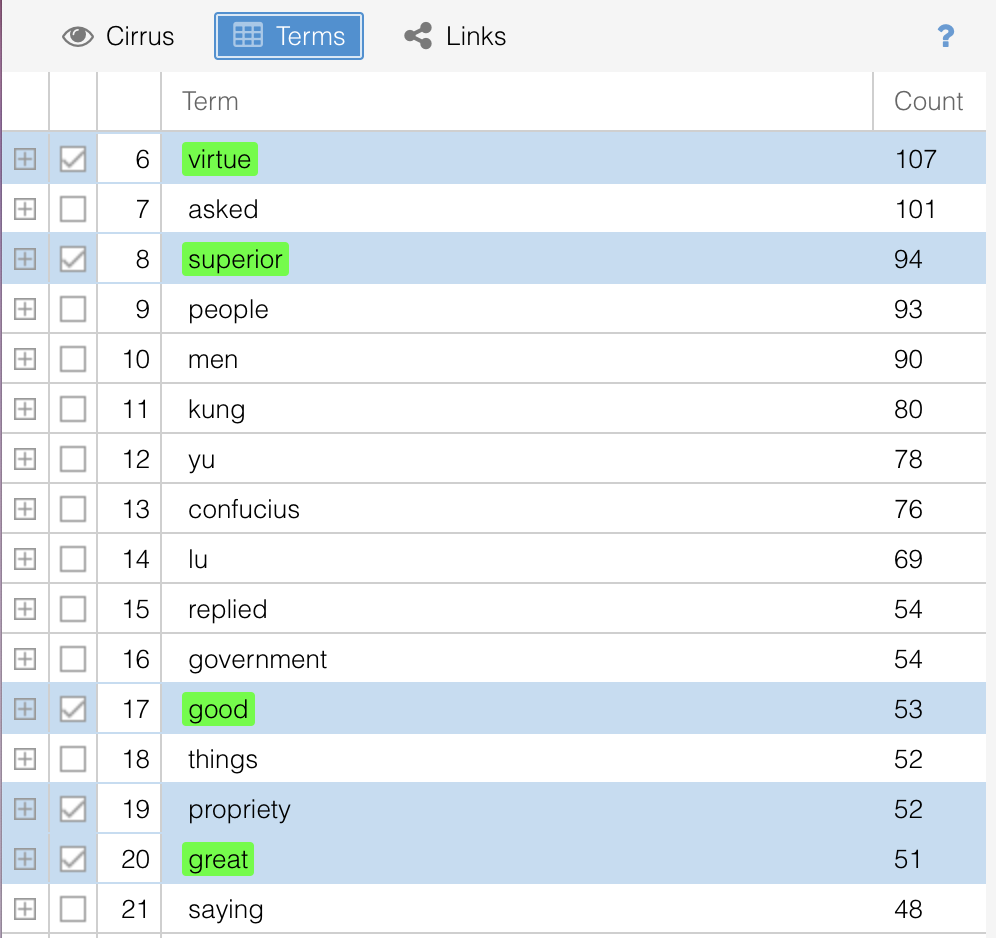
The top 25 words included: said (622), master (521), chap (498), man (232), tsze (186), virtue (107), asked (101), superior (94), people (93), men (90), kung (80), yu (78), confucius (76), lu (69), replied (54), government (54), good (53), things (52), propriety (52), great (51), saying (48), words (46), way (43), prince (41), know (41).
Given The Analects’ dialogic format (“The Master said…”), it is unsurprising that “said,” “master,” and various transliterated names (e.g., “tsze,” “kung,” “yu”) dominate the list. Notably, “chap” (498) references the way the text is segmented—there are actually 499 instances of “chapter,” but the first occurrence is written in full as “chapter,” hence the count discrepancy. This reflects a subtle difference in textual structure, as these divisions may represent short passages rather than modern full-length chapters.
In my analysis of the top 25 words, I focused in particular on five key terms related to Confucian philosophy: virtue, superior, good, propriety, and great. Interestingly, Voyant automatically marked four of these—virtue, superior, good, and great—in green, which in Voyant Tools indicates a positive connotation. In contrast, words with negative connotations (such as “difficult” or “bad”) are typically marked in red, regardless of their frequency. This color coding reflects the inherent sentiment in the language: the green marking here emphasizes the positive, affirming qualities associated with these terms. Although “propriety” was not marked in green, its importance in Confucian thought remains paramount, as it encapsulates the concept of ritual, proper conduct, and social harmony (礼). In contemporary English usage, “propriety” might not always register as overtly positive, but within the context of ancient Chinese culture, it is a deeply affirmative term signifying the moral and societal underpinnings of a harmonious community.
By identifying recurring keywords and patterns, we begin to see how Confucius’s emphasis on virtue, proper conduct, and social order consistently shapes the linguistic landscape of The Analects. A deeper, context-driven approach would be needed to fully grasp how these words function within each passage, but for this midterm project, observing these textual trends already provides a valuable snapshot of Confucius’s central concerns.
From the Voyant-generated trends chart, we can see that the five words—virtue, superior, propriety, great, and good—follow very similar trajectories across the ten document segments. Their peaks and troughs generally coincide, indicating that Confucius often discusses these concepts in close proximity. When one appears more frequently, the others tend to do so as well, suggesting a tight thematic interconnection. Essentially, when Confucius focuses on the qualities of moral excellence (virtue, great, good), he also emphasizes the hierarchical or guiding principle (superior) and the importance of proper conduct (propriety). This synchronicity reflects the text’s broader aim of defining an ideal moral framework where all these values support and reinforce one another.
Next, by adding government and people to the analysis, we extend the comparison to seven key words. Their overall trend lines also align closely, underscoring how Confucius’s thought merges personal virtue, social order, and governance into one cohesive system. Trend lines for people and government have been highly aligned throughout the text, which indicates that in Confucian thought, these two aspects are fundamentally inseparable—each reinforcing the moral quality of the other. In particular, the trend lines for people, government, and virtue nearly overlap between segments 5 and 7, illustrating that in the latter half of The Analects, Confucius increasingly addresses how individual morality and collective ethics—both in the people and in governance—are interdependent. This finding reinforces the notion that cultivating personal virtue is inseparable from establishing a just and virtuous political order.
Presentation
(Website Design Decisions)
I created a dedicated subdomain on my Reclaim Hosting account to showcase my analysis of The Analects of Confucius. I opted for a clean, minimalist design that prioritizes clarity and ease of navigation, ensuring that the analysis results remain the focal point. The website is organized into several clearly delineated sections—Introduction, Sources, Process, Presentation, and Significance—allowing visitors to easily follow the project’s workflow with each section distinctly separated.
(Embed/Illustration Decisions)
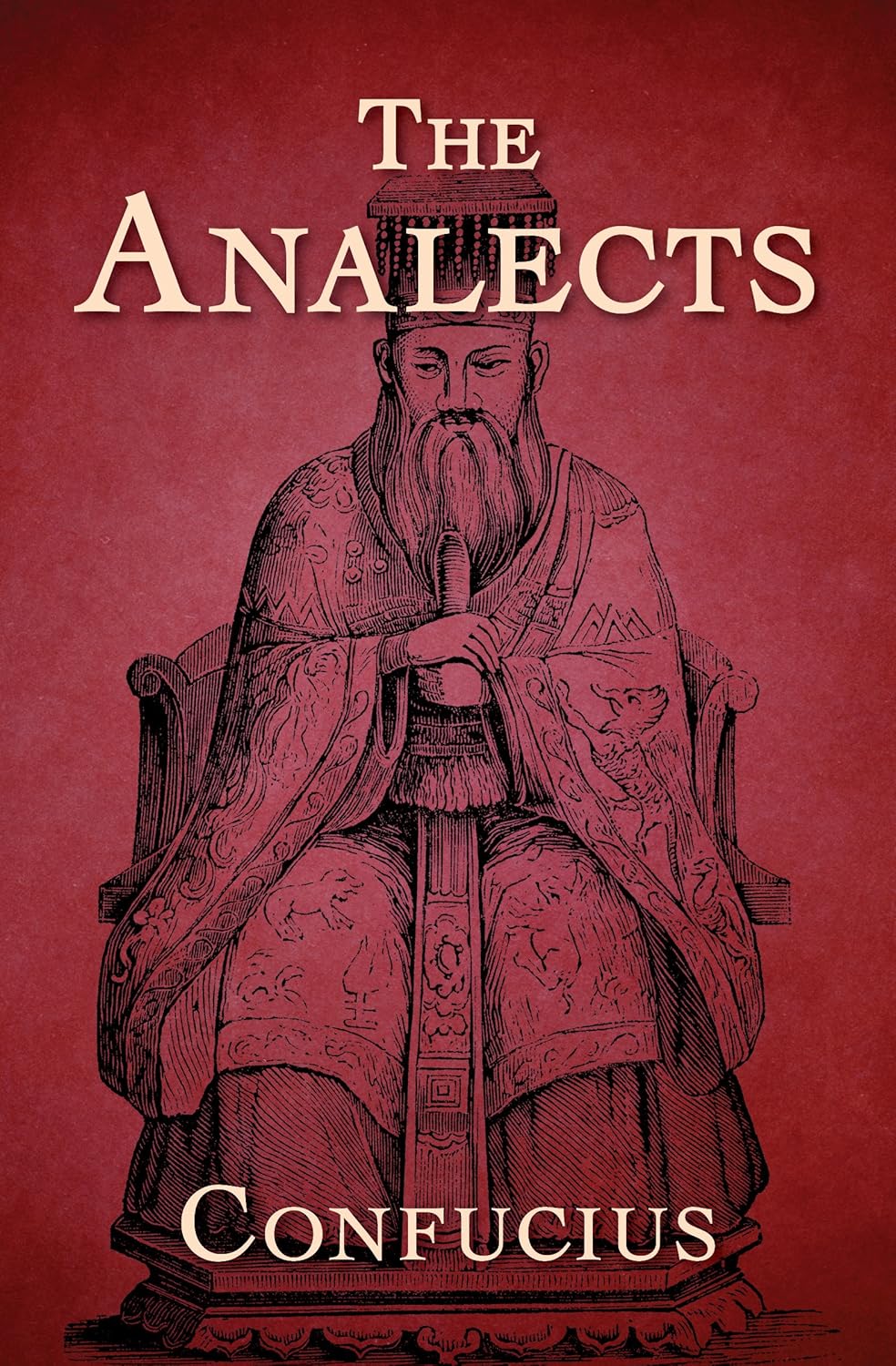
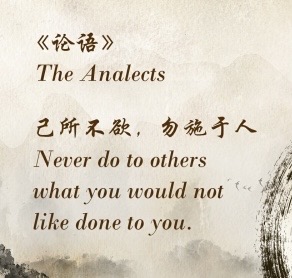
In the Data Visualization section, I embedded interactive Voyant Tools visualizations using iframe code. This design enables visitors to interact directly with the word cloud and trend graphs by clicking on specific words to display corresponding trend lines—viewing them individually, side-by-side, or in various combinations. In addition, I provided several static images, including the book cover, a notable quote from the text, and a display of the word list. These visual elements offer further context and underscore key findings, such as the modern tool’s tendency to mark virtue and good in green (indicating positive connotations), while not marking propriety similarly despite its affirmative meaning in the ancient Chinese context. This deliberate design and embed decision not only enhances user experience but also highlights the challenges of cross-cultural textual analysis.
Together, these decisions have resulted in an accessible and highly interactive platform that effectively showcases digital methodologies and emphasizes the enduring significance of Confucian philosophy.
Significance
(Insights Gained from the Digital Approach)
Applying this digital approach to The Analects of Confucius has illuminated recurring lexical patterns and thematic clusters. For example, the analysis revealed synchronous peaks among key terms—virtue, superior, good, propriety, and great—which, along with the highly aligned trends for people and government, illustrate how Confucian thought consistently interweaves individual morality with collective ethics. In particular, the overlapping trends for people, government, and virtue between segments 5 and 7 suggest that Confucius viewed ethical behavior in society and a virtuous government as mutually reinforcing. These findings underscore the idea that cultivating personal virtue is inseparable from establishing a just and virtuous political order.sights Gained from the Digital Approach)
(Relation to Digital Arts & Humanities vs. Data Science)
This project highlights the distinctive strengths of Digital Arts & Humanities, which prioritize interpretive, contextual, and cultural analysis over the generalized pattern extraction typical of data science. Modern tools like Voyant can quantitatively reveal trends and correlations; however, they require a nuanced interpretation to account for historical and cross-cultural contexts. Unlike data science—which often focuses on predictive modeling and statistical generalizations—Digital Arts & Humanities leverages these quantitative insights to foster a deeper, more holistic understanding of classical texts, bridging modern analytical techniques with traditional humanistic scholarship.
(Potential Pitfalls)
Despite its advantages, this digital method also presents challenges. One significant pitfall is the risk of oversimplification: modern analytical tools may reduce complex cultural and philosophical nuances to mere numbers and visual patterns. For instance, while Voyant marks words like virtue and good in green to indicate positive connotations, it does not similarly mark propriety—a term that, in its ancient Chinese context, carries a profoundly affirmative meaning. This discrepancy can lead to misinterpretations if the results are taken at face value without proper contextual analysis. Additionally, a reliance on quantitative data may obscure subtler rhetorical and philosophical elements that require traditional close reading. These issues underscore the necessity of integrating digital methods with conventional humanistic inquiry to achieve a balanced and informed interpretation.